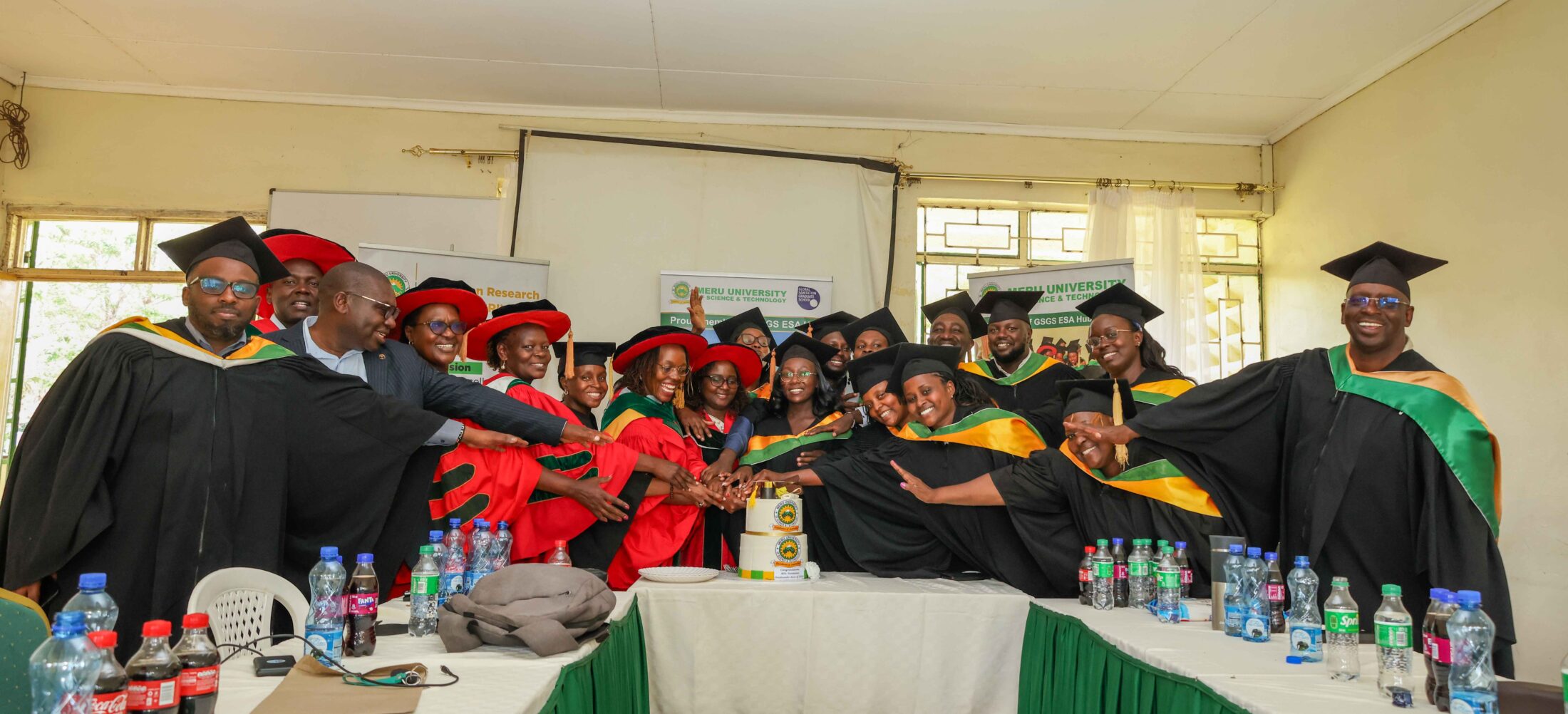
Meru University Celebrates Historic Milestone in Sanitation Education

The Meru University of Science and Technology (MUST), through its Sanitation Research Institute (SRI), has celebrated a significant milestone in advancing sanitation education and research, graduating 14 Master of Science (MSc) in Sanitation students and awarding its first ever Doctor of Philosophy (PhD) in Sanitation to a female scholar.
The achievement, marked during the University’s 14th graduation ceremony, reflects growing efforts to strengthen professional expertise and develop the next generation of sanitation leaders equipped to address emerging challenges in Kenya and beyond.
Of the 14 MSc graduates, eight were women, representing 57.1% of the cohort. Together with the institution’s first female PhD graduate in Sanitation, this milestone underscores the increasing participation of women in sanitation research, technical leadership, and environmental sciences.
The graduating cohort brings specialised knowledge in non sewered sanitation, faecal sludge management, and urban sanitation economics, contributing to ongoing efforts to improve sanitation service delivery.
Their expertise comes at a critical time as Kenya advances reforms aimed at achieving Citywide Inclusive Sanitation (CWIS), an approach that promotes equitable access to safely managed sanitation services for all urban residents.
The graduates are expected to contribute to strengthening sanitation systems, improving regulatory compliance, and supporting sustainable service delivery across county governments and Water and Sanitation Service Providers.
The graduation also marks an important achievement in promoting gender inclusion within the sanitation sector.
The University’s pioneering female PhD graduate conducted research focusing on sanitation governance, equity, and regulatory compliance, contributing valuable knowledge to the development of inclusive sanitation systems.
Speaking on the significance of the achievement, Prof. Joy N. Riungu, Director of the Sanitation Research Institute, emphasised the importance of developing specialised expertise to support national sanitation reforms.
“This graduation is not merely an academic ceremony; it is a vital injection of specialized expertise into a sector that underpins public health, dignity, and economic productivity.”
Dr. Lilian Kirimi, Coordinator of Postgraduate Sanitation Programs, similarly highlighted the significance of increased female representation, noting that women graduates are well-positioned to contribute to utility management, regulatory standards, and inclusive sanitation service delivery.
The Global Sanitation Graduate School (GSGS) celebrates this milestone as an important contribution to strengthening sanitation education, research, and professional capacity development.
Through the continued advancement of postgraduate training and applied research, institutions such as MUST are helping build the expertise needed to address sanitation challenges and accelerate progress towards sustainable and inclusive sanitation services across Africa.
The graduation represents not only an academic achievement but also a meaningful step towards developing skilled professionals capable of transforming sanitation systems and improving public health outcomes.