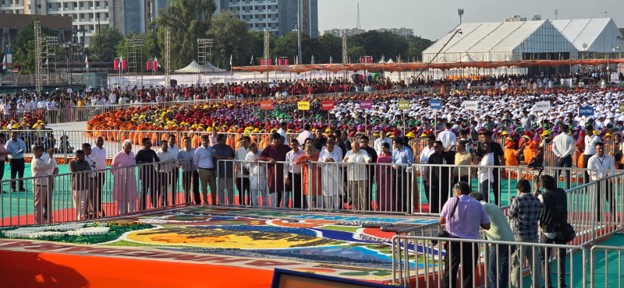
GSGS RH India students at CEPT University showcase Ahmedabad’s WASH challenges through a creative public display

Students enrolled in the Master’s in Urban Infrastructure (MUI) programme at CEPT University, supported by the Global Sanitation Graduate School Regional Hub India (GSGS RH India), developed an impressive 30 × 30 ft installation made entirely from recycled materials to showcase Ahmedabad’s key challenges related to water supply, stormwater management, solid waste, and used water. The installation was unveiled on 6 October 2026 at the GMDC Ground in Ahmedabad, India.
The initiative emerged from the students’ ongoing academic work on Water, Sanitation and Hygiene (WASH). Following discussions of their findings with the Municipal Commissioner of Ahmedabad Municipal Corporation (AMC), the 34 students took on the challenge of translating their academic insights into a creative public exhibition that would bring these urban challenges to the attention of a much wider audience.
The installation formed part of the AMC Seva Sankalp Abhiyan, organised to mark 20 years of good governance in Gujarat. The event was organised by AMC and the AMC School Board in coordination with the Government of Gujarat. Chaired by the Hon’ble Chief Minister of Gujarat, the event provided an important platform to showcase the students’ work. The Chief Minister spent considerable time learning about the installation from the Municipal Commissioner and also felicitated the Deputy Registrar of CEPT University in recognition of the students’ contribution.
The installation remained on display at GMDC Ground for approximately 20 days. During this period, the venue also hosted the Navratri celebrations, attracting around one million visitors over nine days. This provided an exceptional opportunity to bring important urban WASH challenges to the attention of a large and diverse public audience.
The initiative perfectly reflects the vision of GSGS Regional Hub India: connecting academic education with professional practice and real-world challenges. By taking their classroom findings beyond the university and presenting them directly to city leaders and the public, the students demonstrated how academic learning can contribute to greater awareness, public engagement, and more informed approaches to urban infrastructure management.
This initiative is an excellent example of learning beyond the classroom, where students become active contributors to urban development and agents of change in their communities. It also demonstrates the GSGS commitment to educating a new generation of sanitation and urban infrastructure professionals who can translate knowledge into practical impact.