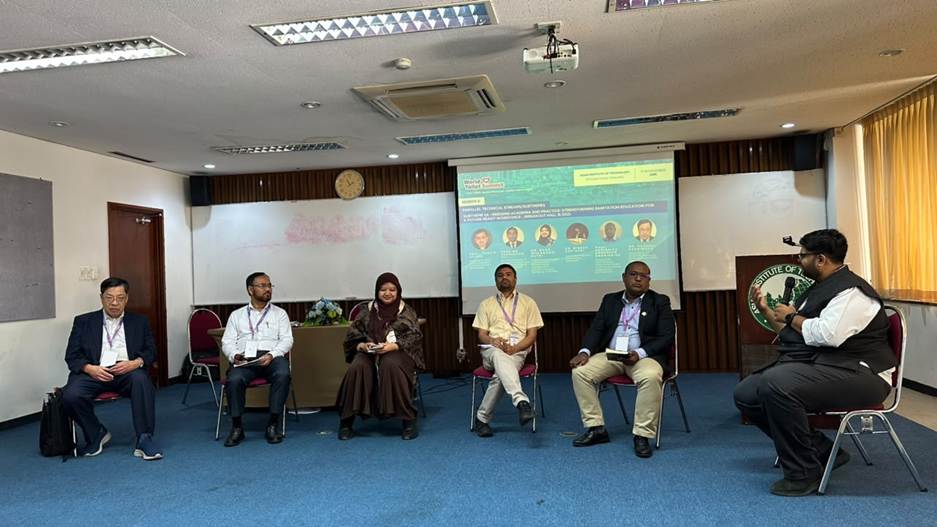
GSGS RH India curates panel discussion on ‘Bridging Academia and Practice’ at the World Toilet Summit 2026

The Global Sanitation Graduate School Regional Hub India (GSGS RH India) moderated a panel discussion on strengthening sanitation education at the World Toilet Summit 2026, held at the Asian Institute of Technology (AIT) campus in Bangkok, Thailand. The session, entitled Bridging Academia and Practice, took place on 19 November 2026 and was moderated by Mr. Siddh Doshi, Team Lead of GSGS Regional Hub India at CEPT University. It brought together representatives from three GSGS Regional Hubs and an expert from the Asian Development Bank Institute (ADBI).
The discussion was part of Sub-theme 5, Beyond Infrastructure: The Human Engine of Sanitation Operations and Maintenance. It was led by GSGS Regional Hub South and Southeast Asia (GSGS RH SSEA), with support from GSGS Regional Hub India. The World Toilet Summit 2026, hosted jointly by the World Toilet Organization (WTO) and AIT, took place from 17 to 19 November 2026.
Prof. Tanvir Ahmed opened the GSGS session with welcome remarks and an introduction to the topic. Mr. Doshi subsequently presented the Global Sanitation Graduate School and the participating Regional Hubs before moderating a panel featuring:
- Mr. Kazushi Hashimoto, Consultant, Asian Development Bank Institute (ADBI)
- Dr. Dyan Wulandari Putri, Lecturer and Head of the Water and Sanitation Infrastructure Management Study Program, Institut Teknologi Bandung
- Prof. Shahjahan Ali, Professor, Khulna University of Engineering and Technology
- Dr. Bikash Adhikari, Associate Professor, Kathmandu University
- Prof. Harinaivo Anderson Andrianisa, Professor, International Institute for Water and Environmental Engineering (2iE) and Director, GSGS Regional Hub West, Central, and Indian Ocean Africa (GSGS RH WCIOA).
The discussion started from a fundamental principle: sanitation systems can only succeed when the people responsible for operating, maintaining, managing, and regulating them are adequately trained.
During the first round, panellists examined how academic curricula have evolved to respond to the needs of the sanitation workforce. They shared experiences with teaching approaches and tools, including live case studies and exposure visits, and identified opportunities to make sanitation education more relevant to real-world professional practice.
The second round focused on the future and the gaps that GSGS aims to address. Panellists discussed the knowledge and skills that young professionals entering the sanitation sector should acquire, the potential development of a shared regional module on sanitation workforce development, and the commitments academic institutions should make to bridge the gap between classroom learning and practical, field-ready competencies.
An open question-and-answer session provided participants with an opportunity to contribute their perspectives and engage directly with the panellists. The session concluded with key takeaways from Mr. Siddh Doshi and Prof. Tanvir Ahmed.
Beyond the panel discussion itself, the session aimed to establish a shared platform for South-South knowledge exchange, enabling GSGS Regional Hubs and other Water, Sanitation and Hygiene (WASH) education programmes across the Global South to exchange teaching methods, practical experiences, and educational resources. It also sought to develop actionable recommendations for strengthening WASH curricula in participating countries.
The vision of GSGS Regional Hub India is to bridge the gap between academic education and professional practice by bringing real-world experiences, practical examples, and field-based learning into the classroom. Through collaboration among universities, regional hubs, development partners, and sanitation practitioners, GSGS aims to ensure that future sanitation professionals are equipped not only with theoretical knowledge but also with the practical competencies needed to address the sector’s challenges.
The World Toilet Summit 2026 provided another valuable opportunity for GSGS to demonstrate how regional and international academic collaboration can strengthen sanitation education and contribute to building a skilled workforce for sustainable sanitation worldwide.